For 125 years, charge hours have been the go-to metric for measuring performance at an accounting firm. However, when firms focus on input hours to measure value created for clients, they disincentivize creativity, innovation, and efficiency. In short, superstar employees are punished for their efficiency by being given more work.
As we look to the future, I propose that firms do not hire people for their chargeable hours; rather, they should hire employees for the revenue they can generate for the firm. You might think these mindsets are one and the same, but they are totally different.
What if we shifted our mindset to focus on the revenue generated by our team members instead of their charge hours? What could we achieve? Before we jump ahead to results, it is important to talk through how we can make the change and, most importantly, how we talk about it with our team.
In this article series, you will:
- Learn the straightforward math to convert your primary performance metric from charge hours to revenue generated without tracking any new data.
- Learn how to use the combination of charge hours, realization, and utilization to tell the story of how someone met, missed, or exceeded their revenue goal.
- Learn how to start the change management process within your teams so your leaders and team members believe in this change you are making.
To be clear, I am not suggesting that you stop tracking hours or charge hours. I believe that hours are an important metric because they let us know our capacity. We are currently in an environment where there is more work than people, and it’s going to be that way for a while.
However, the key question is no longer, “How many hours do I have to work to get all of my tasks done?” The right questions are, “How many hours do I want to work? What client base gives me the ability to make the money I want to make while working those hours?”
This is a critical distinction; after all, we don’t have to work as much as we used to work to make enough money to be happy and content with our lives. If we took on all the work we possibly could, we would never stop working, and we would never be able to enjoy the personal part of our lives. There’s simply too much to do. Instead, we must proactively create the work environment we want and then protect it.
Work smarter, not harder
These days, we hear a lot of the same, tired sentiments: “The current generation doesn’t want to work as hard as my generation.” For one, no kidding — working that much sucks. Sacrificing family and personal time is not worth it. And you know where we learned it from? You.
Remember Nancy Reagan’s “Just Say No” campaign ad, where the Dad busts into his son’s room and is giving him the business about smoking weed? The Dad says, “Where did you learn this, son?!” And the son says: “I learned it from watching you!”
It’s like that, but in a good way. Hear me out.
When we grew up, there was no remote work. When your generation took time off to take us on vacation or spend the weekend with us, we got 100% of you. There were no phones dinging, no emails on the laptop at home ... we got you with no work distractions. Honestly, we loved it. When we got all of you, you imparted lessons on us like: “You can change the world. You can make a difference. You can create the future you want.” You filled us with hope, and you encouraged us to create fantastic lives. You taught us the value of family time, personal time, recreation, and the joy we get out of living life to the fullest.
What we’re doing now is exactly that. The landscape we work in has fundamentally shifted, and it is undergoing one of the greatest changes we will ever see: the technological revolution. We can leverage technology in ways your generation could not to complete work in less time, but with the same value to the client. The equation used to look like this:
Rate X Time = The value to the client has been rendered 100% obsolete.
In the first part of this article series, we’re going to talk about how to take the first steps to shift your practice away from focusing on charge hours as your primary metric for employee evaluation and client value.
We will replace those with revenue generated by each employee and billing for the value the client receives regardless of the hours put into the project.
We’re going to start with the easier of the two first: revenue generated by employee. This is the simple math that I mentioned at the outset. We can find this by multiplying metrics we already track. That’s right: we don’t have to track anything new. We just have to do the math and evaluate the results. And we’re accountants — we’re experts at that.
The metrics we will use are charge hours, realization, and assigned rate. Each year, you are likely setting charge hour goals and realization expectations, and you’ve made up a rate and assigned it to each employee. Multiply all three of those metrics together, and that’s the revenue you can expect.
Let’s walk through some charts that may look familiar:
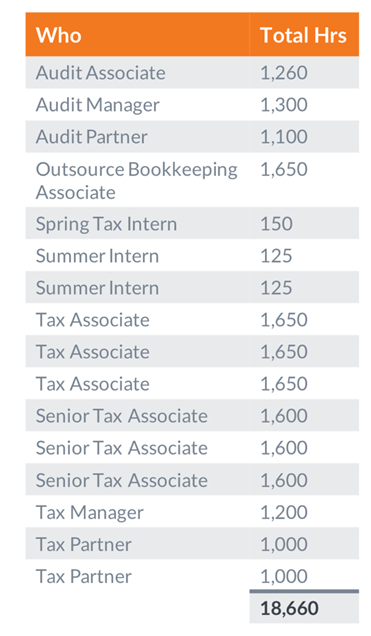
This is real data from one of our Aprio offices that is a similar size to many mid-sized firms. Look at the annual charge hour budget for different roles.
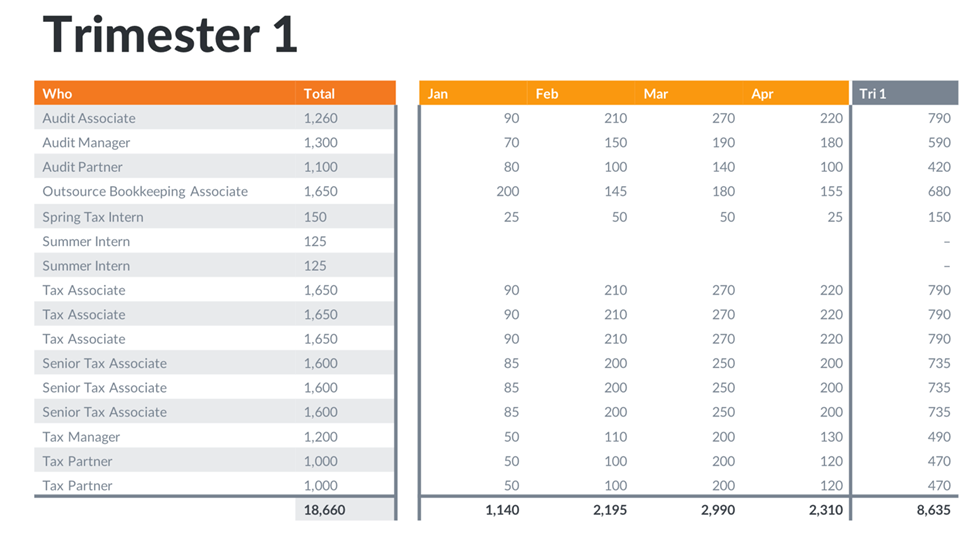
Now, let’s break it down by month based on the seasonality of the role. To make it digestible, let’s focus on trimester 1:
Now let’s turn it into revenue, using our rates and a 75% realization expectation:

Our chart is now organized differently to highlight our primary focus: revenue generated.
To help put this into context, I’m going to offer a personal story that will allow you to see the impact of what we’re talking about here. Let’s set the scene: I’m sitting in my last partner review at my previous firm. I crushed it that year — I exceeded my revenue generation by 50%, beating my $1.2 million budget by $600,000 and billing $1.8 million. However, I did it in 900 hours instead of the 1,200 hours I was “supposed” to bill. Let me ask you a question: which figure matters more, hours or revenue?
I kid you not, the first item leadership brought up during the review was how I was going to make up 300 hours in the upcoming year. I answered the question honestly:
Me: “I generated $600,000 of revenue over budget.”
Them: “But if you work more, we make more.”
Me: “You might, but I don’t.”
Them: “But more revenue is also good for your scorecard.”
Me: “But I beat my revenue by 50% … why would I work more?”
Them: “We need you to add 300 hours.”
Me: “You know what I can do with those 300 hours? Give me your 10 best senior managers who want to be partners. I’ll show them how I was twice as efficient as you expected me to be. I’ll show them how to generate more revenue working less hours. I’ll make it so there is no way they will ever want to leave this place. And I’ll do it year after year after year. We’ll create a generation of partners who can make a lot of money and have a life for themselves and their teams.”
Them: “… No. You need to work more.”
I immediately wrote a letter of resignation and delivered it the day after my year-end bonus cleared. Nobody was going to change their mind, and I refused to be punished for being awesome. Essentially, they wanted me to regress to the mean — to perform worse, so I fit into the traditional box we’ve created with these outmoded metrics.
You’re thinking of someone right now, aren’t you? The superstar in your firm. How do you remember her body language? Is she excited, buoyant, and happy? Or are her shoulders slouched, looking like she’s going through the motions? Have you wondered how to get her back to being happy at her job?
That is the impact of having a singular focus on charge hours and not understanding that revenue generated is what we hire people to do.
In the next segment of our series, we’ll talk about how you can start the change management process within your teams so that your leaders and team members believe in this change you are making.
Have questions in the meantime? Don’t hesitate to contact me at mike.max@aprio.com.